
Market Overview:
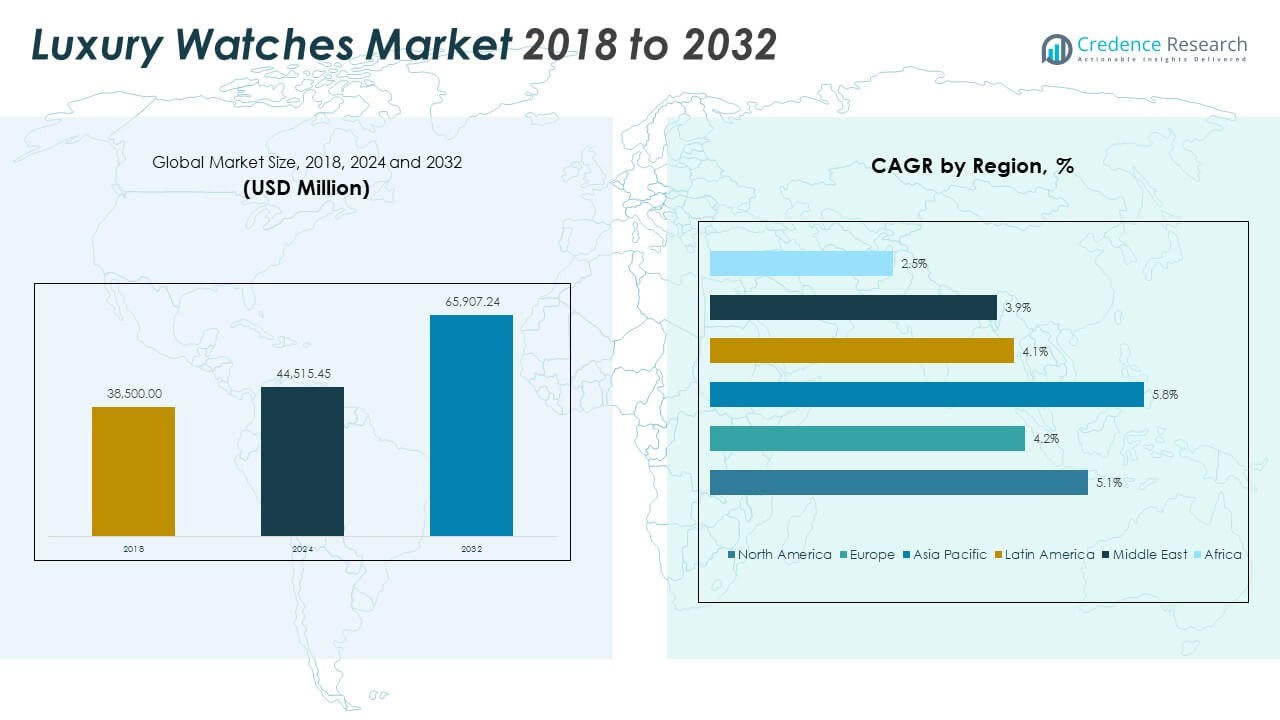
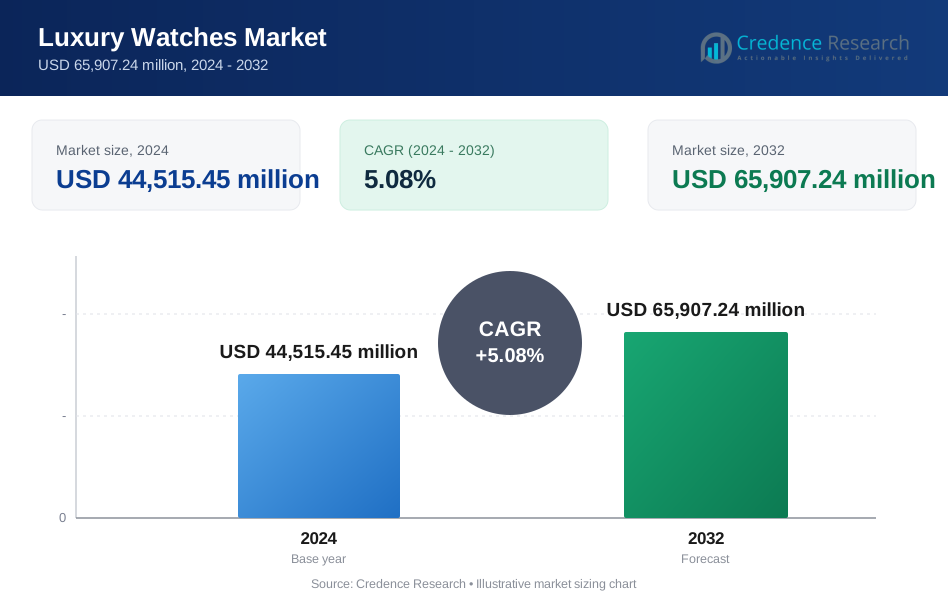
The Global Luxury Watches Market size was valued at USD 38,500.00 million in 2018, increased to USD 44,515.45 million in 2024, and is anticipated to reach USD 65,907.24 million by 2032, at a CAGR of 5.08% during the forecast period.
| REPORT ATTRIBUTE | DETAILS |
|---|---|
| Historical Period | 2020-2023 |
| Base Year | 2024 |
| Forecast Period | 2025-2032 |
| Luxury Watches Market Size 2024 | USD 44,515.45 Million |
| Luxury Watches Market, CAGR | 5.08% |
| Luxury Watches Market Size 2032 | USD 65,907.24 Million |
The market is driven by rising consumer preference for premium timepieces as a symbol of status and craftsmanship. Growth in disposable income, expanding high-net-worth individual populations, and brand collaborations with celebrities enhance market visibility. Technological advances such as smart luxury watches and limited-edition collections attract younger consumers while maintaining exclusivity and prestige, fostering continued global demand.
Europe leads the market, supported by heritage brands from Switzerland, France, and Italy. North America follows with high luxury spending and strong retail presence. The Asia-Pacific region, particularly China, Japan, and India, is emerging rapidly due to urbanization, rising affluence, and a growing appetite for premium fashion goods. The Middle East also shows potential, driven by luxury tourism and brand-conscious consumers.
Market Insights:
- The Global Luxury Watches Market was valued at USD 38,500.00 million in 2018, projected to reach USD 44,515.45 million in 2024, and is expected to attain USD 65,907.24 million by 2032, expanding at a CAGR of 5.08% during the forecast period.
- Asia Pacific leads the market with about 47.0% share, driven by rising disposable incomes, fashion-conscious consumers, and strong luxury retail growth in China, Japan, and India.
- North America (21.0%) and Europe (20.8%) follow, supported by established luxury brands, high purchasing power, and mature retail infrastructure sustaining demand for premium timepieces.
- The Asia Pacific region, with its fastest growth rate of 5.8%, benefits from expanding urban populations, increasing brand penetration, and strong millennial demand for modern and hybrid designs.
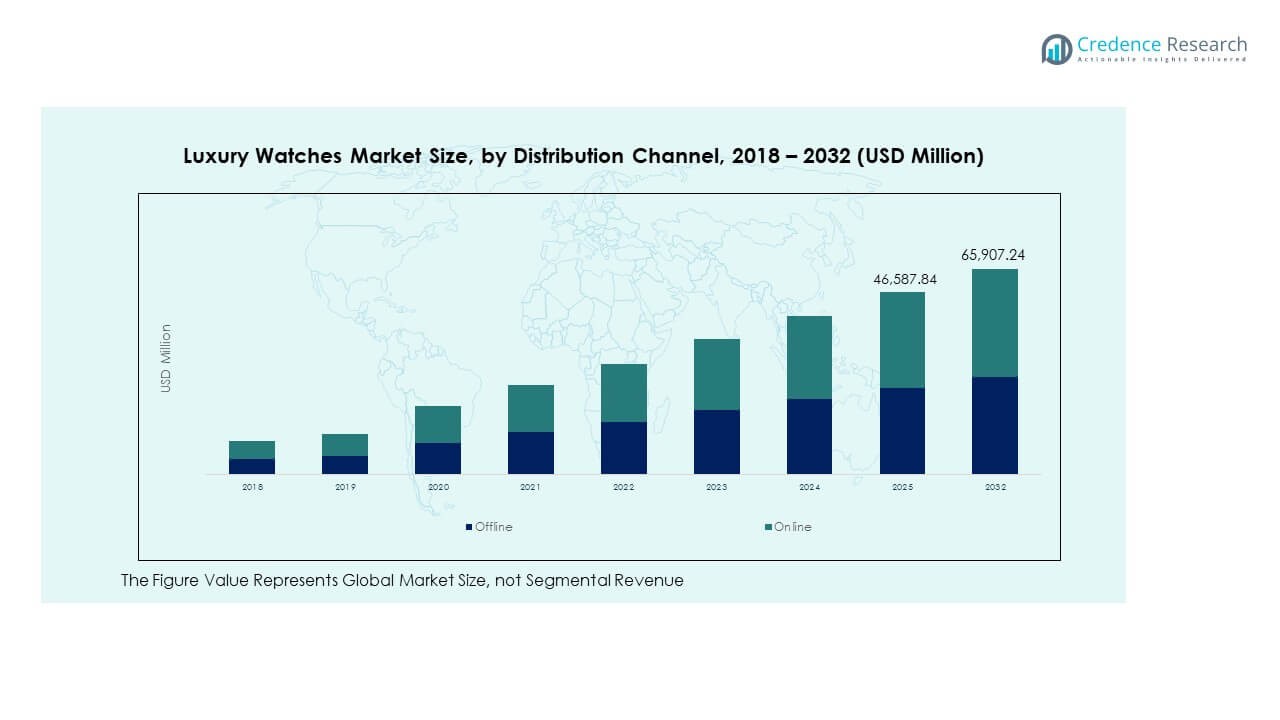
- Based on the chart, offline distribution accounts for nearly 60% of market sales, reflecting brand trust and personalized buying experiences, while online channels contribute about 40%, fueled by digital retail expansion and virtual showroom accessibility.
Market Drivers:
Rising Global Affluence and Growing High-Net-Worth Population
The Global Luxury Watches Market benefits from an expanding base of affluent consumers worldwide. Economic growth in emerging economies has created a strong middle and upper-income class seeking high-end goods. Wealth accumulation among professionals and entrepreneurs increases demand for luxury accessories that reflect social status. It attracts consumers seeking craftsmanship, exclusivity, and prestige. Rising disposable income in regions like Asia-Pacific and the Middle East fuels purchase frequency. Luxury watch brands target this demographic through tailored marketing campaigns and limited editions. The industry’s appeal lies in emotional value and lifestyle association. The rise of high-net-worth individuals continues to strengthen market expansion.
- For instance, in 2024, Asia-Pacific represented 41.72% of luxury watch sales, with China and India leading new buyer growth and North American HNWIs (aged 18–39) reporting 44% making multiple watch purchases annually.
Strong Heritage Branding and Craftsmanship Appeal
The market is driven by heritage craftsmanship, precision engineering, and brand legacy. Consumers associate Swiss, Italian, and French luxury watches with artistry and technical excellence. Renowned brands maintain loyal clientele through quality assurance and timeless design. It sustains consumer trust by emphasizing handmade components and traditional production. Collectors view luxury watches as both wearable art and investment pieces. Marketing strategies focus on brand storytelling and authenticity. The emphasis on craftsmanship differentiates premium timepieces from mass-produced products. This commitment to legacy supports long-term brand equity.
- For instance, Swiss brands require “Swiss Made” certification, ensuring that at least 60% of a watch’s value is produced domestically, and that luxury mechanical watches contain up to 1,000+ hand-assembled components, each manufactured to micron tolerances.
Technological Integration and Product Innovation
Innovation in luxury watches enhances both functionality and appeal. The introduction of hybrid and smart-luxury watches attracts tech-conscious customers. The Global Luxury Watches Market integrates features like health monitoring, GPS, and connectivity without losing elegance. Brands experiment with sustainable materials, advanced alloys, and innovative mechanisms. It drives consumer engagement through customization and design flexibility. Product diversification ensures relevance across generations. Collaborations with tech companies open new customer segments. This synergy between tradition and innovation reinforces market competitiveness.
Expanding Retail Channels and Personalized Consumer Experience
Evolving retail infrastructure amplifies accessibility to luxury timepieces. Flagship stores, digital boutiques, and authorized dealers strengthen consumer reach. Personalized experiences, including private consultations and bespoke services, enhance exclusivity. The Global Luxury Watches Market leverages omnichannel strategies to blend digital and physical engagement. It encourages brand loyalty through online customization and post-sale care. Celebrity endorsements and influencer collaborations extend brand visibility. Premium after-sales services build repeat purchase intent. Continuous evolution of retail experience drives sustainable growth.
Market Trends:
Shift Toward Smart Luxury Watches and Hybrid Designs
Technological convergence shapes consumer preferences for luxury timepieces. Brands are integrating smart functionalities within classic designs to retain traditional aesthetics. The Global Luxury Watches Market embraces hybrid watches blending mechanical precision and digital intelligence. It appeals to younger consumers seeking modern practicality. Smart features like notifications and health tracking enhance daily utility. Leading players invest in R&D to innovate without compromising craftsmanship. Demand for connected luxury models is increasing across urban demographics. The fusion of elegance and technology defines this emerging trend.
Sustainability and Ethical Sourcing in Watchmaking
Environmental consciousness influences purchasing behavior among luxury consumers. Brands focus on sustainable materials, recycled metals, and traceable gemstones. The Global Luxury Watches Market adapts production processes to meet ethical standards. It prioritizes eco-friendly packaging and responsible supply chains. Consumers value transparency about origin and sustainability certifications. This shift strengthens brand image and attracts environmentally aware buyers. Companies are adopting circular design principles to minimize waste. Sustainability now represents a competitive advantage in luxury watchmaking.
- For instance, Panerai offers watches like the Submersible QuarantaQuattro eSteel™, which features a case made of a high percentage of recycled steel and a strap crafted from recycled PET bottles. Other brands such as Oris produce the Aquis Date Upcycle, which uses a unique dial made from recycled PET plastic recovered from ocean waste, and many Swiss plants now utilize renewable energy and implement refurbishment programs for certified pre-owned watches to minimize waste across the industry.
Rise of Limited Editions and Customization Culture
Exclusivity remains a strong selling factor for luxury watches. Brands are producing limited-edition collections to create scarcity and desirability. The Global Luxury Watches Market emphasizes personalization through engraving, color, and strap selection. It enhances emotional connection by allowing customers to co-create designs. Collectors appreciate unique releases tied to cultural or historical themes. Digital configurators empower clients to preview bespoke options. This personalization trend builds deeper engagement and loyalty. The focus on rarity strengthens the value perception of premium timepieces.
Digital Transformation and Growth of Online Luxury Retail
E-commerce reshapes how consumers access luxury brands. Online flagship stores and virtual showrooms improve convenience and brand experience. The Global Luxury Watches Market invests in secure digital platforms and AR try-on tools. It benefits from global online marketplaces targeting luxury buyers. Brands now engage customers through storytelling and social media platforms. Influencer collaborations boost visibility among tech-savvy audiences. The digital channel supports cross-border sales and faster outreach. Integration of digital retail ensures steady long-term growth.
Market Challenges Analysis:
Counterfeit Production and Pricing Pressure in Competitive Segments
The Global Luxury Watches Market faces significant challenges from counterfeit goods and imitation products. Counterfeits reduce brand value, confuse customers, and impact revenues. It forces brands to invest heavily in authentication and anti-counterfeit technologies. Parallel imports and grey-market sales further distort pricing structures. The presence of mid-range luxury competitors increases pricing pressure. Consumers expect exclusivity but also value practicality, forcing a delicate balance. Rising production costs due to premium materials add strain on profit margins. Maintaining brand prestige while expanding accessibility remains complex for major players.
Changing Consumer Preferences and Market Saturation Risks
Consumer behavior is evolving with shifting priorities toward smart and minimalist designs. The Global Luxury Watches Market must adapt to modern fashion cycles and digital lifestyles. It risks losing relevance among younger demographics preferring multifunctional devices. Rapid innovation cycles can dilute traditional craftsmanship appeal. Market saturation in developed regions limits new growth potential. Economic downturns or inflation can reduce discretionary luxury spending. Balancing innovation with brand heritage poses an ongoing strategic challenge. Companies must align product development with emerging lifestyle shifts to sustain appeal.
Market Opportunities:
Rising Demand in Emerging Economies and Youth-Oriented Segments
Emerging markets in Asia-Pacific, the Middle East, and Latin America present untapped growth avenues. Rising disposable incomes and urban lifestyles stimulate luxury consumption. The Global Luxury Watches Market capitalizes on aspirational buying behavior among younger consumers. It expands brand portfolios to target entry-level luxury buyers. Regional events and cultural endorsements enhance visibility. Expansion of local distribution networks strengthens reach. Brands emphasizing modern designs with heritage craftsmanship attract new demographics. Youth-driven demand continues to shape future market direction.
Expansion Through Digital Platforms and Experiential Retail Innovation
Digital transformation unlocks new opportunities for customer engagement. Virtual showrooms, metaverse retailing, and AR-enabled experiences redefine luxury purchasing. The Global Luxury Watches Market leverages these platforms to enhance accessibility without losing exclusivity. It utilizes data analytics for targeted marketing and personalized service. Hybrid retail experiences connect online convenience with in-store luxury. Innovative collaborations with fashion and technology sectors broaden customer bases. The expansion of digital ecosystems supports sustained brand relevance and profitability.
Market Segmentation Analysis:
By Product Type
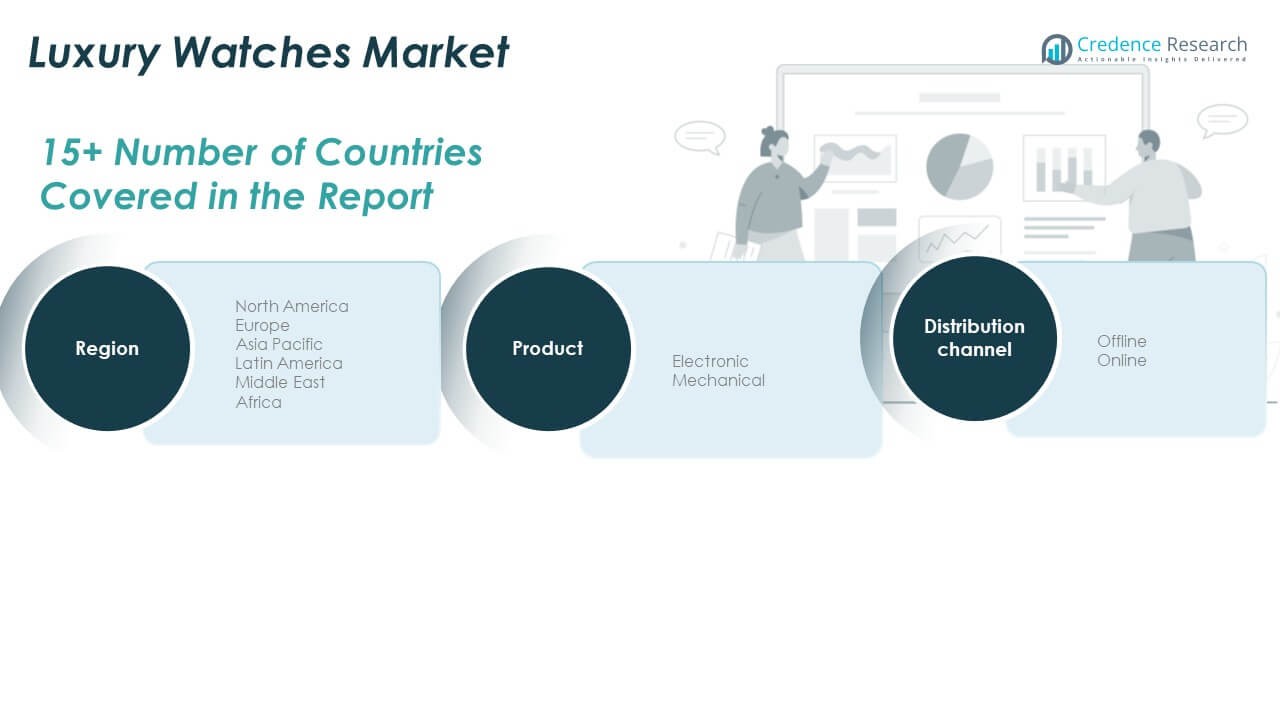
The Global Luxury Watches Market is segmented into electronic and mechanical categories, reflecting evolving consumer preferences and technological integration. Electronic watches, driven by smart features and hybrid functions, attract younger buyers seeking convenience with luxury aesthetics. Mechanical watches remain dominant due to their craftsmanship, precision, and heritage appeal. Collectors and enthusiasts value manual and automatic timepieces as symbols of legacy and artistry. It sustains market balance by blending innovation with traditional excellence. The coexistence of both types supports broad demographic reach. Mechanical models reinforce brand prestige, while electronic variants ensure modernization and relevance.
- For instance, mechanical watches accounted for approximately 55% of global luxury watch production in 2024, while major brands expanded digital sales via AR-powered virtual showrooms alongside flagship boutiques to maximize reach.
By Distribution Channel
The market is segmented into offline and online channels, each contributing distinct advantages. Offline retail, through flagship stores and authorized dealers, remains vital for personalized luxury experiences. It enables direct brand engagement and trust through exclusivity and service quality. Online sales are growing rapidly, supported by secure e-commerce platforms and digital marketing strategies. Consumers increasingly prefer online channels for convenience, variety, and accessibility. The integration of virtual showrooms and augmented-reality tools enhances digital shopping. Leading brands leverage omnichannel approaches to reach global customers. The balance between offline luxury and online efficiency strengthens long-term growth potential.
Segmentation:
By Product Type
- Electronic
- Mechanical
By Distribution Channel
- Offline
- Online
By Region
- North America
- US
- Canada
- Mexico
- Europe
- UK
- France
- Germany
- Italy
- Spain
- Russia
- Rest of Europe
- Asia Pacific
- China
- Japan
- South Korea
- India
- Australia
- Southeast Asia
- Rest of Asia Pacific
- Latin America
- Brazil
- Argentina
- Rest of Latin America
- Middle East
- GCC Countries
- Israel
- Turkey
- Rest of Middle East
- Africa
- South Africa
- Egypt
- Rest of Africa
Regional Analysis:
North America
The North America Luxury Watches Market size was valued at USD 8,277.50 million in 2018 to USD 9,374.69 million in 2024 and is anticipated to reach USD 13,847.23 million by 2032, at a CAGR of 5.1% during the forecast period. North America holds an estimated 21.0% market share of the Global Luxury Watches Market. Strong purchasing power, established retail networks, and consumer preference for premium accessories drive regional growth. The U.S. dominates with high brand penetration and luxury awareness. It benefits from a mature e-commerce infrastructure and expanding luxury watch collections. Canada and Mexico show rising demand supported by urbanization and income growth. Collaborations with local influencers enhance market reach. Technological integration and sustainability trends are influencing consumer choices across this region.
Europe
The Europe Luxury Watches Market size was valued at USD 8,932.00 million in 2018 to USD 9,872.31 million in 2024 and is anticipated to reach USD 13,692.40 million by 2032, at a CAGR of 4.2% during the forecast period. Europe commands around 20.8% market share, supported by strong heritage brands from Switzerland, France, Italy, and Germany. The region is home to major luxury houses with global brand equity. It benefits from a strong tourism sector and high consumer loyalty to legacy brands. Demand for mechanical watches remains dominant due to craftsmanship and tradition. It continues to drive exports through leading manufacturers. Rising demand from younger luxury consumers promotes hybrid designs. The European market remains a cornerstone for innovation and timeless artistry.
Asia Pacific
The Asia Pacific Luxury Watches Market size was valued at USD 16,632.00 million in 2018 to USD 19,713.48 million in 2024 and is anticipated to reach USD 30,930.32 million by 2032, at a CAGR of 5.8% during the forecast period. Asia Pacific leads the global market with an estimated 47.0% share, driven by expanding affluent populations in China, Japan, and India. The market thrives on rising disposable income, fashion consciousness, and rapid urban development. It benefits from growing luxury retail networks and digital adoption. China remains the largest consumer base for high-end timepieces. Japan and South Korea contribute significantly through design innovation and strong domestic demand. It witnesses surging interest from millennials and Gen Z segments. Regional luxury hubs continue to attract international investments and flagship expansions.
Latin America
The Latin America Luxury Watches Market size was valued at USD 2,348.50 million in 2018 to USD 2,688.29 million in 2024 and is anticipated to reach USD 3,682.24 million by 2032, at a CAGR of 4.1% during the forecast period. Latin America holds roughly 5.6% of the global share, fueled by Brazil, Mexico, and Argentina. Rising middle-class income and fashion exposure are increasing luxury demand. The market benefits from expanding retail infrastructure and digital channels. It experiences growing brand collaborations with local influencers. Currency volatility and import tariffs limit faster penetration. It continues to attract aspirational buyers seeking prestige and exclusivity. Luxury tourism and e-commerce advancements are enhancing accessibility across key cities.
Middle East
The Middle East Luxury Watches Market size was valued at USD 1,578.50 million in 2018 to USD 1,718.01 million in 2024 and is anticipated to reach USD 2,313.71 million by 2032, at a CAGR of 3.9% during the forecast period. The region accounts for about 3.5% of the global share, driven by the Gulf Cooperation Council (GCC) countries. Wealth concentration, cultural affinity for luxury, and strong retail networks sustain steady demand. It benefits from high-end tourism and international brand events in Dubai and Riyadh. The UAE remains a key hub for premium watch retailing. Regional consumers favor limited editions and exclusive launches. Diversification in retail formats supports growth. Growing youth interest in modern watch designs strengthens market opportunities.
Africa
The Africa Luxury Watches Market size was valued at USD 731.50 million in 2018 to USD 1,148.68 million in 2024 and is anticipated to reach USD 1,441.34 million by 2032, at a CAGR of 2.5% during the forecast period. Africa holds around 2.1% of the global share, led by South Africa, Egypt, and Nigeria. Economic expansion and urban development stimulate demand for premium accessories. It witnesses rising luxury retail investments in major cities. Affluent consumers prefer mechanical and Swiss-made timepieces. Currency fluctuations and limited brand presence restrict rapid growth. Online sales channels are expanding, improving product access. The region offers long-term potential as consumer purchasing power gradually improves.
Key Player Analysis:
- Apple Inc.
- The Swatch Group Ltd
- Audemars Piguet Holding S.A.
- Fossil Group, Inc.
- Citizen Watch Company of America, Inc.
- Seiko Watch Corporation
- Compagnie Financière Richemont SA
- LVMH Moët Hennessy - Louis Vuitton
- Movado Group Inc.
- Ralph Lauren Corporation
Competitive Analysis:
The Global Luxury Watches Market is highly competitive, marked by established heritage brands and innovative entrants. It features key players such as Rolex, Patek Philippe, Audemars Piguet, LVMH, Richemont, and Swatch Group, which dominate through strong brand identity and craftsmanship. Companies compete on design excellence, exclusivity, and distribution expansion. It continues to evolve with smart-luxury integrations and sustainability-driven production. Strategic alliances, influencer partnerships, and limited-edition collections strengthen market visibility. Regional and independent brands are gaining traction through personalization and online presence. Continuous innovation and prestige-based marketing define the competitive landscape.
Recent Developments:
- In October 2025, TAG Heuer (under LVMH) launched its first “Made for iPhone” luxury smartwatch, transitioning away from Google’s Wear OS platform to a custom operating system for seamless digital integration with iOS users. This strategic product launch reflects LVMH's ongoing focus on tech-enabled luxury.
- In September 2025, Apple Inc. launched the Apple Watch Series 11 and Watch Ultra 3, introducing advanced health features such as hypertension alerts, improved sleep tracking, 5G connectivity, and extended battery life. These new luxury models debuted alongside broader enhancements to Apple's smartwatch lineup, marking a significant step in wearable technology for health-conscious and luxury consumers.
- In August 2025, Audemars Piguet acquired a majority stake in Swiss precision component supplier Inhotec SA, reinforcing its vertical integration and supporting the continuity of expertise for the haute horlogerie ecosystem. The acquisition ensures innovation and industrial strength in high-end watchmaking.
Report Coverage:
The research report offers an in-depth analysis based on product type and distribution channel. It details leading market players, providing an overview of their business, product offerings, investments, revenue streams, and key applications. Additionally, the report includes insights into the competitive environment, SWOT analysis, current market trends, as well as the primary drivers and constraints. Furthermore, it discusses various factors that have driven market expansion in recent years. The report also explores market dynamics, regulatory scenarios, and technological advancements that are shaping the industry. It assesses the impact of external factors and global economic changes on market growth. Lastly, it provides strategic recommendations for new entrants and established companies to navigate the complexities of the market.
Future Outlook:
- Demand for hybrid and smart-luxury watches will expand across younger demographics.
- Sustainability and ethical sourcing will become central to brand strategies.
- Asia-Pacific will remain the fastest-growing regional market.
- Personalization and limited editions will enhance customer engagement.
- Digital and omnichannel retail will drive new revenue streams.
- Innovation in materials and design will attract tech-savvy buyers.
- Heritage brands will retain dominance through authenticity and legacy.
- Collaborations between fashion and tech sectors will increase.
- Demand for certified pre-owned luxury watches will grow.
- Global tourism recovery will stimulate luxury retail performance.
Request a Free Sample
Fill in your details and we'll send you a free sample report.
- Sample data tables & charts
- Research methodology
Need a Custom Version of This Report?
Tailor the scope, geography, or segments to your exact requirements.
- Custom geography or segment scope
- Direct access to our analyst team
Frequently Asked Questions
What is the current market size for Global Luxury Watches Market, and what is its projected size in 2032?
Q: At what Compound Annual Growth Rate is the Global Luxury Watches Market projected to grow between 2025 and 2032?
Which Global Luxury Watches Market segment held the largest share in 2024?
What are the primary factors fueling the growth of the Global Luxury Watches Market?
Who are the leading companies in the Global Luxury Watches Market?
Which region commanded the largest share of the Global Luxury Watches Market in 2024?
Table of Content
Chapter 1. Report Introduction
- 1.1 Report Description & Purpose
- 1.1.1 Report Title & Market Definition
- 1.1.2 Unique Selling Propositions (USP) & Key Differentiators
- 1.1.3 Value Proposition for Stakeholders
- 1.2 Research Objectives
- 1.2.1 Market Sizing Objectives (Volume & Revenue)
- 1.2.2 Segmentation Objectives
- 1.2.3 Competitive Intelligence Objectives
- 1.2.4 Forecast & Scenario Objectives
- 1.3 Report Scope
- 1.3.1 Luxury Watches Scope – Types & Subtypes Covered
- 1.3.2 Geographic Scope – Regions & Countries Covered
- 1.3.3 Historical Period, Base Year & Forecast Period (2024; forecast to 2032)
- 1.3.4 Inclusions & Exclusions
- 1.4 HS Code & Classification Framework
- 1.5 Currency, Units & Pricing Basis
- 1.6 Target Stakeholders
- 1.7 Limitations & Assumptions
Chapter 2. Executive Summary
- 2.1 Global Luxury Watches Market Snapshot
- 2.1.1 Market Size – Historical (2024) & Forecast (2024-2032) (2024: USD 44,515.45 million → 2032: USD 65,907.24 million)
- 2.1.2 Volume & Revenue – Global Totals
- 2.1.3 Key Market Highlights – Top Five Facts
- 2.2 Luxury Watches Market Segmentation Snapshot
- 2.2.1 Market Split by Region – 2024 vs. 2032
- 2.3 Competitive Snapshot
- 2.3.1 Top 10 Players by Revenue Share – 2024
- 2.3.2 Top 10 Players by Volume Share – 2024
- 2.3.3 Recent Strategic Developments (18-Month Summary)
- 2.4 Key Investment Highlights & Strategic Conclusions
Chapter 3. Luxury Watches Market Dynamics & Industry Analysis
- 3.1 Market Overview & Context
- 3.1.1 Luxury Watches Market Position in the Broader Automotive Value Chain
- 3.1.2 OEM vs. Replacement Market Dynamics
- 3.1.3 Market Maturity & Development Stage by Region
- 3.2 Luxury Watches Market Drivers
- 3.3 Luxury Watches Market Restraints & Challenges
- 3.4 Luxury Watches Market Opportunities
- 3.5 Porter's Five Forces Analysis
- 3.5.1 Threat of New Entrants
- 3.5.2 Bargaining Power of Suppliers
- 3.5.3 Bargaining Power of Buyers
- 3.5.4 Threat of Substitutes
- 3.5.5 Competitive Rivalry – Intensity Assessment
- 3.6 Luxury Watches Value Chain Analysis
- 3.6.1 Upstream – Raw Material/Input Suppliers
- 3.6.1.1 Raw Material/Input 1
- 3.6.1.2 Raw Material/Input 2
- 3.6.1.3 Raw Material/Input 3
- 3.6.2 Midstream – Production/Manufacturing/Service Delivery
- 3.6.2.1 Production/Process Overview
- 3.6.2.2 Key Facility Locations & Capacity by Manufacturer
- 3.6.3 Downstream – Distribution & End Consumer
- 3.6.3.1 Primary Channel – B2B/OEM
- 3.6.3.2 Secondary Channels – Dealer, Retail, Online, Direct
- 3.6.4 Value Chain Profitability Analysis
- 3.6.1 Upstream – Raw Material/Input Suppliers
- 3.7 PESTEL Analysis
- 3.7.1 Political Factors
- 3.7.2 Economic Factors
- 3.7.3 Social Factors
- 3.7.4 Technological Factors
- 3.7.5 Environmental Factors
- 3.7.6 Legal Factors
- 3.8 Luxury Watches Supply Chain Analysis
- 3.8.1 Raw Material/Input Supply Risk Assessment
- 3.8.2 Manufacturing Concentration Risk (Geographic Exposure)
- 3.8.3 Trade Disruption Impact Analysis
- 3.9 Regulatory & Policy Landscape
Note: The regulatory and policy landscape section covers regulations based on their applicability to the market, Luxury Watches category, geography, and scope of the study. Only regulatory frameworks with a material impact on operations, compliance, trade, sustainability, or market access are analyzed in detail.
Chapter 4. Key Investment Pockets & Opportunity Analysis
- 4.1 Luxury Watches Market Attractiveness Analysis
- 4.1.1 By Region – Investment Attractiveness Matrix (Volume × CAGR)
- 4.2 Absolute Revenue Growth Opportunity
- 4.2.1 By Region – Absolute USD Growth Through 2032
- 4.3 Incremental Volume Opportunity
- 4.3.1 By Region – Incremental Volume Through 2032
- 4.3.2 Segment – Incremental Volume
- 4.4 Emerging Submarket Opportunity Deep Dive (Subject to Applicability)
- 4.5 Emerging Market Opportunity Scorecards
- 4.5.1 United States
- 4.5.2 Europe
- 4.5.3 Asia
- 4.5.4 Middle East & Africa
Note: Emerging Market Opportunity Scorecards will be included based on relevance and strategic importance. Regions listed are indicative and may vary depending on data availability and market dynamics.
Chapter 5. Luxury Watches Import-Export Analysis & Trade Flows
- 5.1 Global Trade Overview
- 5.1.1 Global Export Value by Country (2024)
- 5.1.2 Global Export Volume by Country (2024)
- 5.1.3 Global Import Value by Country (2024)
- 5.1.4 Global Import Volume by Country (2024)
- 5.1.5 Net Trade Balance by Country (2024)
- 5.2 Export Analysis – Segment
- 5.2.1 Type 1 (HS Code)
- 5.2.2 Type 2 (HS Code)
- 5.2.3 Type 3 (HS Code)
- 5.2.4 Type 4 (HS Code)
- 5.2.5 Type 5 (HS Code)
- 5.3 Import Analysis – Segment
- 5.3.1 Type 1 (HS Code)
- 5.3.2 Type 2 (HS Code)
- 5.3.3 Type 3 (HS Code)
- 5.3.4 Type 4 (HS Code)
- 5.3.5 Type 5 (HS Code)
- 5.4 Average Unit Trade Prices
- 5.4.1 Average Export Price – Segment & Country
- 5.4.2 Average Import Price – Segment & Source Country
- 5.4.3 Price Trends (2024)
- 5.5 Key Trade Route Analysis
- 5.5.1 Trade Route 1
- 5.5.2 Trade Route 2
- 5.5.3 Trade Route 3
- 5.5.4 Trade Route 4
- 5.5.5 Trade Route 5
- 5.6 Trade Policy Impact Assessment
- 5.6.1 US Anti-Dumping & Section 301 Tariffs
- 5.6.2 EU Customs Union Impact
- 5.6.3 Major Free Trade Agreements
- 5.6.4 USMCA Rules of Origin
Note: Trade policy analysis will be included only where relevant to the Luxury Watches market.
Chapter 6. Competitive Landscape & Company Benchmarking
- 6.1 Luxury Watches Market Concentration & Structure
- 6.1.1 Herfindahl-Hirschman Index (HHI) – vs. 2024
- 6.1.2 Tier 1, Tier 2 & Tier 3 Market Structure
- 6.1.3 Global, Regional & Local Player Dynamics
- 6.2 Luxury Watches Market Share Analysis – 2024
- 6.2.1 Global Revenue Share by Company
- 6.2.2 Global Volume Share by Company
- 6.2.3 Regional Revenue Share
- 6.2.4 Market Share Evolution ( vs. 2024)
- 6.2.5 OEM Segment Share by Company
- 6.2.6 Replacement Segment Share by Company
- 6.3 Production/Delivery Capacity & Facility Analysis
- 6.3.1 Global Installed Capacity
- 6.3.2 Capacity Utilization Rates
- 6.3.3 Production/Output Volume
- 6.3.4 Facility Locations & Capacity Map
- 6.3.5 Planned Capacity Additions
- 6.4 Luxury Watches Competitive Benchmarking Matrix
- 6.4.1 Revenue, Volume, CAGR & Profitability Comparison
- 6.4.2 Channel Revenue Mix
- 6.4.3 Geographic Revenue Exposure
- 6.4.4 R&D Intensity
- 6.4.5 Sustainability Maturity
- 6.5 Strategic Developments in Luxury Watches (Last 24 Months)
- 6.5.1 Mergers, Acquisitions & Divestments
- 6.5.2 New Luxury Watches Launches
- 6.5.3 Facility Expansions
- 6.5.4 Strategic Alliances, Joint Ventures & Partnerships
- 6.5.5 Distribution Expansion & Market Entry
- 6.5.6 Sustainability & ESG Initiatives
- 6.6 Competitive Strategy Mapping
- 6.6.1 Leader, Challenger, Follower & Niche Classification
- 6.6.2 Pricing Strategy Comparison
- 6.6.3 Channel Strategy Matrix
Note: Strategic developments are included based on their materiality and the availability of reliable information.
Chapter 7. Global Luxury Watches Market – By Distribution Channel
- 7.1 Segment Overview
- 7.1.1 Volume & Revenue Split by Channel (2024 & 2032)
- 7.1.2 Channel Mix Evolution (2024-2032)
Chapter 8. Regional Market Analysis – Global Overview
- 8.1 Global Regional Overview
- 8.1.1 Regional Volume Share
- 8.1.2 Regional Revenue Share
- 8.1.3 Regional Volume by Region
- 8.1.4 Regional Revenue by Region
- 8.1.5 Regional Forecast Through 2032
- 8.2 Cross-Regional Segment Analysis
- 8.2.1 By Distribution Channel
- 8.2.2 By Brand/Price Tier
Chapter 9. North America Luxury Watches Market
- 9.1 United States
- 9.2 Canada
- 9.3 Mexico
Chapter 10. Europe Luxury Watches Market
- 10.1 Germany
- 10.2 France
- 10.3 Italy
- 10.4 United Kingdom
- 10.5 Spain
- 10.6 Poland
- 10.7 Russia
- 10.8 Netherlands
- 10.9 Belgium
- 10.10 Sweden
- 10.11 Denmark
- 10.12 Norway
- 10.13 Rest of Europe
Chapter 11. Asia Pacific Luxury Watches Market
- 11.1 China
- 11.2 India
- 11.3 Japan
- 11.4 South Korea
- 11.5 Thailand
- 11.6 Indonesia
- 11.7 Vietnam
- 11.8 Malaysia
- 11.9 Australia
- 11.10 Rest of Asia Pacific
Chapter 12. Latin America Luxury Watches Market
- 12.1 Brazil
- 12.2 Argentina
- 12.3 Colombia
- 12.4 Chile
- 12.5 Rest of Latin America
Chapter 13. Middle East Luxury Watches Market
- 13.1 Saudi Arabia
- 13.2 United Arab Emirates
- 13.3 Turkey
- 13.4 Israel
- 13.5 Iran
- 13.6 Rest of the Middle East
Chapter 14. Africa Luxury Watches Market
- 14.1 South Africa
- 14.2 Egypt
- 14.3 Nigeria
- 14.4 Morocco
- 14.5 Rest of Africa
Chapter 15. Luxury Watches Company Profiles
- 15.1 [Company 01]
- 15.1.1 Company Overview
- 15.1.2 Key Management Personnel
- 15.1.3 Products & Services Portfolio
- 15.1.4 Financial Performance
- 15.1.5 Key Market Focus & Geographic Presence
- 15.1.6 Recent Developments & Strategic Initiatives
Note: The company profile list is preliminary and may change based on research findings, market developments, data availability, and client requirements.
Chapter 16. Appendices
- Appendix A – List of Abbreviations & Acronyms
- Appendix B – Industry Classification Code Reference – Full Series
- Appendix C – Production & Capacity Data Tables
- Appendix D – End-Use & Demand Base Tables
- Appendix E – Consumption & Replacement Rate Assumptions
- Appendix F – ASP Reference Tables
- Appendix G – Manufacturing & Facility Database
- Appendix H – Import-Export Data Tables
- Appendix I – Regulatory Summary Tables
- Appendix J – Primary Research Participant List (Anonymized)
- Appendix K – Primary Research Questionnaire Framework
- Appendix L – Data Sources & Bibliography
- Appendix M – Market Size Divergence & Source Comparison
Chapter 17. Research Methodology
- 17.1 Research Framework & Philosophy
- 17.2 Secondary Research – Sources, Hierarchy & Data Extraction
- 17.3 Data Modeling – Bottom-Up & Top-Down Market Sizing
- 17.4 Primary Research – Stakeholder Framework, LOI & Sample Sizes
- 17.5 Forecast Methodology – Regression, Scenario & Sensitivity Analysis
- 17.6 Quality Control – Four-Layer Validation Framework
- 17.7 Limitations & Standard Assumptions
- 17.8 Disclaimer
